.png)

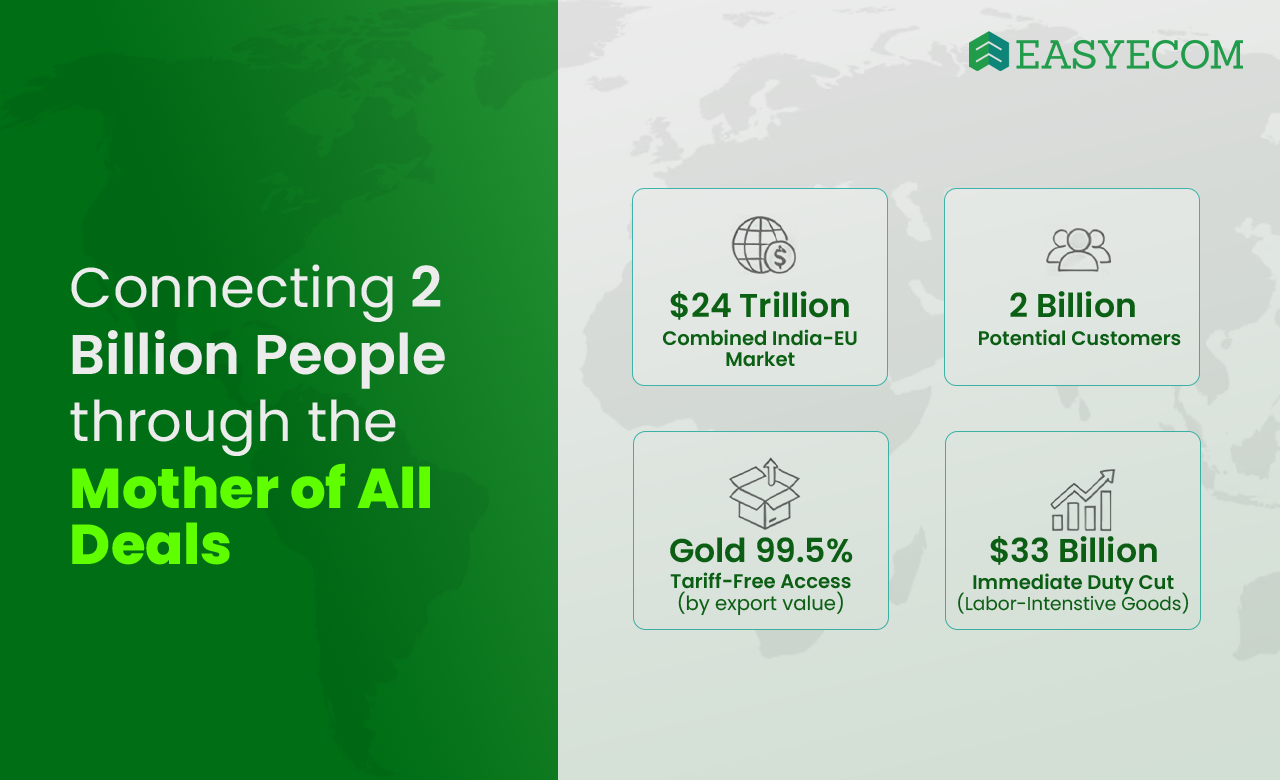
As of January 27, 2026, with the signing of this historic Free Trade Agreement (FTA) between India and the EU (the European Union), a shift occurred in the world of international trade. Often referred to by officials as the "Mother of All Deals," this pact ends nearly two decades of negotiations and opens a $20 trillion market to Indian entrepreneurs.
This deal is one of the most impactful trade pacts India has ever concluded, covering goods, services, investment, and regulatory cooperation. For Indian sellers, especially in eCommerce, this agreement doesn’t just open doors to Europe, it fundamentally shifts the way exports, supply chains, and digital commerce can flourish.
Here’s a deep dive into what the India-EU trade deal means, why it matters right now, and how EasyEcom positions sellers to benefit the most.
What Is the India-EU Free Trade Agreement?
At its core, the major goal of the agreement between India and the EU is to have a free trade agreement (also known as an FTA), which will reduce or eliminate tariffs on most goods and create more efficient ways to conduct trade in services and digital commerce between India and the EU.
The Big Numbers
- The EU and India together represent about 25% of global GDP and a population of ~2 billion people.
- The agreement eliminates or reduces tariffs on roughly 96% of EU exports to India and 99.5% of Indian exports to the EU by value.
- India’s goods exports to the EU (₹11.5 lakh crore in FY25) stood around $75.85 billion, with services trade adding significantly more.
This level of preferential market access marks the largest free trade area India has ever concluded.
What makes this deal especially important is the scale of tariff liberalisation. Once fully implemented, almost all of India's exports to the EU will have preferential access, meaning the cost of exporting them will be lower than in the past and will also enable Indian products to compete much more effectively in the European market.
In other words, this will enable Indian companies to sell their products in the European market at lower prices than they were able to do previously; therefore, there will be fewer barriers to the sale of Indian-made goods to European consumers.
Why the EU Market Is So Attractive for Indian Sellers
The European Union is more than a large market; it is also an exceptionally valuable market. EU Consumers tend to be much more sophisticated than consumers elsewhere (with higher levels of purchasing power), and they are increasingly interested in purchasing ethically produced, sustainable and well-crafted products.
This aligns extremely well with India’s export strengths. Indian sellers are already known for quality textiles, handcrafted products, jewellery, wellness goods, and niche manufacturing. The FTA amplifies this advantage by making these products more accessible to EU buyers.
India’s exports to the EU already exceed $75 billion annually, and trade bodies expect this number to grow significantly over the next decade
For eCommerce sellers, this translates into something very tangible: a massive new demand pool without the historical cost disadvantages.
What Changes Under the India EU FTA
Reduced Tariffs and Better Pricing Power
One of the biggest challenges Indian exporters faced earlier was high import duties in the EU. These duties often reduced margins or forced sellers to price themselves out of competition.
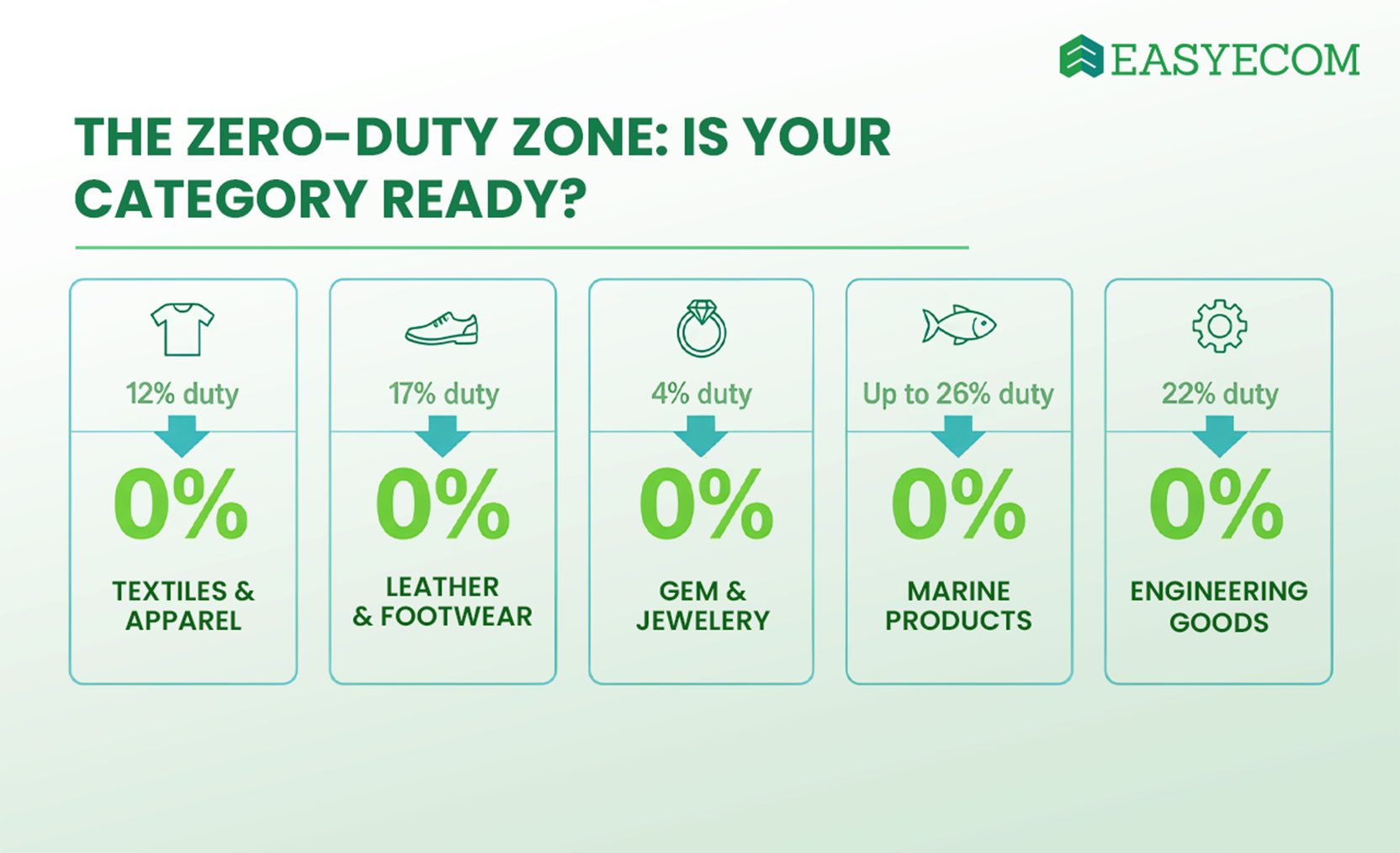
The India EU FTA directly addresses this by reducing or eliminating tariffs across a wide range of product categories. Sectors such as textiles, apparel, leather goods, gems and jewellery, chemicals, pharmaceuticals, and engineering products are expected to benefit the most
For sellers, this doesn’t just mean lower costs. It means greater control over pricing strategy, whether that’s passing savings to customers to gain market share or retaining margins to invest in growth.
Smoother and More Predictable Trade Processes
Beyond tariffs, the agreement also focuses on reducing non-tariff barriers, the hidden frictions that often make international trade complex. These include inconsistent customs procedures, excessive documentation, and unclear regulatory requirements.
Through increased transparency and improved regulatory cooperation, the FTA will create a more predictable trading environment for cross-border transactions between India and the EU.
For eCommerce sellers, predictability matters just as much as cost. When shipping timelines, customs clearance, and documentation requirements are clearer, sellers can plan inventory, marketing, and customer commitments with far more confidence.
Opening Doors for Services and Digital Businesses
The trade deal is not limited to physical goods. It also opens up over 140 services sub-sectors, including IT, software, logistics, and digital services.
This is particularly relevant in today’s commerce landscape, where selling a product is inseparable from the technology that supports it. From order management to logistics orchestration, digital platforms form the backbone of modern trade.
This is where companies like EasyEcom naturally align with the broader vision of the India EU FTA enabling smoother, tech-led cross-border commerce.
What This Means Specifically for Indian eCommerce Sellers
For Indian eCommerce sellers, the India EU trade deal changes the rules of the game. Selling internationally is no longer restricted to large enterprises with deep pockets. Even mid-sized brands and fast-growing D2C players can now realistically enter European markets.
However, cross-border eCommerce brings its own complexity. Sellers must manage inventory across geographies, handle fluctuating demand, and ensure timely fulfilment, all while maintaining profitability.
This is why operational readiness becomes just as important as market access.
Selling internationally requires:
- Multi-warehouse inventory coordination
- Cross-border order routing
- Currency management
- VAT and tax tracking
- Marketplace reconciliation
Without structured systems, growth can quickly turn into operational chaos. This is where EasyEcom becomes a strategic advantage.
How EasyEcom Helps Sellers Unlock the Full Potential of the India-EU Trade Deal
Trade agreements create opportunity. Execution creates growth.
As Indian sellers expand into European markets under the India EU Trade Deal, they face a new level of operational complexity. Managing multiple warehouses, fulfilling cross-border orders, handling VAT compliance, tracking settlements across marketplaces, and analysing profitability by region requires structured systems, not manual processes.
This is where EasyEcom becomes a strategic enabler.
Instead of managing expansion through fragmented tools and spreadsheets, sellers get a centralized, automated and scalable operations platform that supports international growth without operational chaos.
Centralised Inventory Visibility Across Geographies
When entering the EU market, inventory planning becomes significantly more complex. Sellers may operate from:
- Domestic Indian warehouses
- International fulfilment partners
- Marketplace-led fulfilment centres
EasyEcom provides real-time visibility across all locations, ensuring:
- No overselling
- Reduced stockouts
- Smarter replenishment planning
- Better forecasting across regions
This is especially critical when demand spikes due to tariff-driven price competitiveness post-FTA.
Intelligent Order Routing and Cross-Border Fulfilment
Shipping internationally requires careful cost and time optimisation. EasyEcom helps route orders to the most efficient warehouse or fulfillment partner, reducing delivery timelines and protecting margins.
With smoother customs processes expected under the India EU FTA, operational efficiency becomes the differentiator between sellers who merely enter the EU and those who scale successfully.
Accurate Financial Reconciliation Across Marketplaces
International marketplaces operate with varying commission structures, tax deductions, and settlement cycles. Manual reconciliation often leads to financial blind spots.
EasyEcom automates reconciliation and provides clarity on:
- Marketplace payouts
- Commission deductions
- Tax calculations
- Region-wise revenue tracking
This ensures sellers maintain control over profitability as they expand globally.
Enabling Multi-Currency Expansion Across EU Markets
One of the most important and often underestimated aspects of EU expansion is multi-currency management.
While many EU countries use the Euro (EUR), several member states operate in their own currencies, such as:
- Polish Zloty (PLN)
- Swedish Krona (SEK)
- Danish Krone (DKK)
For Indian sellers, this introduces another layer of operational complexity. Revenue may be generated in multiple currencies, while core business expenses remain partly in INR. Exchange rate fluctuations can directly impact margins if not properly tracked.
Without structured systems, sellers often face:
- Manual currency conversions
- Inaccurate profitability tracking
- Margin erosion due to exchange volatility
- Difficulty comparing performance across EU markets
EasyEcom simplifies this process by providing:
- Centralised tracking of orders and payouts across currencies
- Consolidated financial reporting with region-wise performance visibility
- Clear settlement reconciliation across international marketplaces
- Data-backed insights that help optimise pricing country by country
In the context of the India–EU Trade Deal, tariff reductions improve competitiveness. Multi-currency clarity ensures those gains translate into real profitability.
Final Thoughts: The Advantage Will Belong to the Prepared
India's European Union Free Trade Agreement is not just another policy accomplishment; it is an opportunity for Indian companies to engage with one of the world's largest economic powers. Together, the elimination of barriers such as providing preferential tariff treatment on goods imported or exported from India, streamlining regulations, providing greater access to services, and aligning digital trade legislation, has enabled Indian suppliers to pursue their international market goals without the prior limitations they had.
But access alone does not guarantee success.
The sellers who win in this new era will not simply be the ones who enter Europe first, they will be the ones who enter it prepared. Prepared with operational clarity. Prepared with financial visibility. Prepared with scalable systems that turn opportunity into sustainable growth.
The FTA reduces friction at the borders. EasyEcom removes friction inside the business.
As Europe opens its doors wider to Indian goods and digital commerce, the real question for sellers is no longer “Can we go global?”, it is “Are we operationally ready to scale globally?”
The India–EU Trade Deal creates the opportunity.
Execution will define the outcome.